

“You talk when you cease to be at peace with your thoughts.” ― Kahlil Gibran, The Prophet
The Prophet was published in 1923.
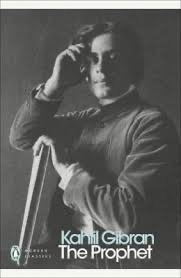
Kahlil Gibran’s masterpiece, The Prophet, is one of the most beloved classics of our time. The Prophet has been translated into over 100 different languages, making it one of the most translated books in history and the American editions alone have sold more than nine million copies.
He was called “filthy” because his skin was dark, unintelligent because he could barely speak English. When he arrived in this country, he was placed in a special class for immigrants. But, a few of his teachers saw something in the way he expressed himself, through his drawings, through his view of the world. He would soon master his new language.
His mother had made a difficult decision to take him, his two younger sisters and a half-brother to America, seeking a better life for their family. They settled in Boston’s South End, at the time the second-largest Syrian-Lebanese-American community. The family would struggle and the young boy would lose one sister and his half-brother to tuberculosis. His mother would die of cancer.
He would write, “Out of suffering have emerged the strongest souls; the most massive characters are seared with scars.”
He was born in poverty on January 6, 1883 in what is now modern day Lebanon.
He believed in love, he believed in peace, and he believed in understanding.
The Prophet are quoted at weddings, in political speeches and at funerals, inspiring influential figures such as John F. Kennedy, Indira Gandhi, Elvis Presley, John Lennon, and David Bowie.
He was very outspoken, attacking hypocrisy and corruption. His books were burned in Beirut, and in America, he would receive death threats.
Gibran was the only member of his family to pursue scholastic education. His sisters were not allowed to enter school, primarily because of financial difficulties. Gibran, however, was inspired by the strength of the women in his family, especially his mother. After one sister, his mother, and his half-brother died, his other sister, Mariana would support Gibran and herself by working at a dressmaker’s shop.
Of his mother, he would write:
“The most beautiful word on the lips of mankind is the word ‘Mother,’ and the most beautiful call is the call of ‘My mother.’ It is a word full of hope and love, a sweet and kind word coming from the depths of the heart. The mother is everything – she is our consolation in sorrow, our hope in misery, and our strength in weakness. She is the source of love, mercy, sympathy, and forgiveness.”
Gibran would later champion the cause of women’s emancipation and education.
He believed that “Safeguarding the rights of others is the most noble and beautiful end of a human being.”
In a poem to new immigrants, he would write, “I believe you can say to the founders of this great nation. ‘Here I am. A youth. A young tree. Whose roots were plucked from the hills of Lebanon. Yet I am deeply rooted here. And I would be fruitful.‘”
Gibran’s Life:
Like any other guy, he met and dated some beautiful women. But the love story with Mary Haskell caught my attention.
{Gibran held the first art exhibition of his drawings in January 1904 in Boston at Day’s studio.[6]During this exhibition, Gibran met Mary Haskell, the headmistress of a girls’ school in the city, nine years his senior. The two formed a friendship that lasted the rest of Gibran’s life. Haskell would spend large sums of money to support Gibran and would also edit all of his English writings. The nature of their romantic relationship remains obscure; while some biographers assert the two were lovers[39] but never married because Haskell’s family objected,[15] other evidence suggests that their relationship was never physically consummated.[6] Gibran and Haskell were engaged briefly between 1910 and 1911.[40] According to Joseph P. Ghougassian, Gibran had proposed to her “not knowing how to repay back in gratitude to Miss Haskell,” but Haskell called it off, making it “clear to him that she preferred his friendship to any burdensome tie of marriage.”[41] Haskell would later marry Jacob Florance Minis in 1926, while remaining Gibran’s close friend, patroness and benefactress, and using her influence to advance his career.[42] –} Wikipedia
Well, this is not everything…
{After his death, going through his papers, Barbara Young (his secretary) and Haskell discovered that Gibran had kept all of Mary’s love letters to him. Young admitted to being stunned at the depth of the relationship, which was all but unknown to her. In her own biography of Gibran, she minimized the relationship and begged Mary Haskell to burn the letters. Mary agreed initially but then reneged, and eventually they were published, along with her journal and Gibran’s some three hundred letters to her, in [Virginia] Hilu’s Beloved Prophet.}
I think that love scenarios repeats in different ways. There is always a Gibran out there.

 Carolina Mom